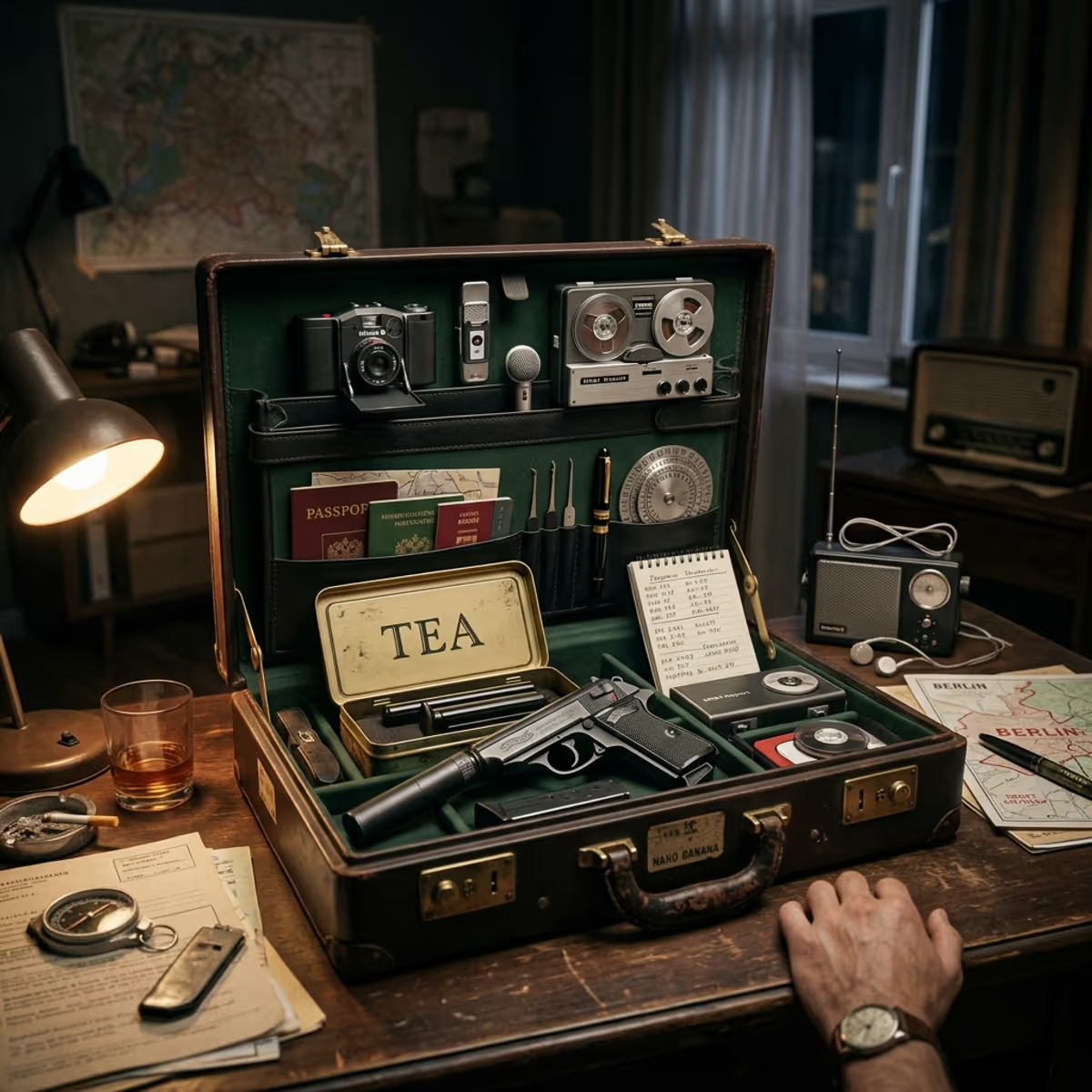
The Cold War was fought largely away from battlefields. It was a contest of intercepts, secrets, and paranoia in which the decisive weapon was rarely a warhead and usually a single piece of well-timed intelligence. To get that intelligence, the CIA and the KGB poured serious resources into building an arsenal of covert devices.
These were nothing like the laser watches and ejector seats of cinema. They were working tools with narrow jobs: extract classified material, communicate off the grid, and occasionally eliminate a target without a sound. Some were brilliant. Some were absurd. All of them are real.
The “Kiss of Death”: The Lipstick Pistol
To a border guard it was a tube of lipstick. Inside, it was a single-shot 4.5mm pistol built for close-range assassination, a KGB device from the 1960s that Western officers nicknamed the “kiss of death.”
The engineering was simple. The base of the tube served as the grip, the cap concealed the barrel, and a twist plus a hidden trigger fired the round. Its genius was its ordinariness: it passed through checkpoints that would have caught any conventional weapon.

A Prick of Poison: The Bulgarian Umbrella
In September 1978, the Bulgarian dissident writer Georgi Markov was waiting at a London bus stop when he felt a sharp sting in the back of his thigh. He turned to see a man pick up a dropped umbrella, apologize, and disappear into the crowd. Four days later Markov was dead.
The cause was a platinum-iridium pellet the size of a grain of sand, fired into his leg by a modified umbrella with a pneumatic mechanism. The pellet had been coated with ricin. The weapon, widely attributed to KGB technical support for the Bulgarian service, became one of the most infamous pieces of tradecraft hardware ever built: an assassination device meant for use in broad daylight, in public, against a man waiting for a bus.
The Shoe with the Heel Transmitter
Some of the era’s best bugging never required breaking into anything. It just required intercepting a package. In one well-documented case from the 1960s and 70s, the Romanian security service exploited the fact that Western diplomats posted to Bucharest ordered their shoes from abroad. The shoes were intercepted in transit, fitted with a transmitter and battery buried in the heel, and delivered to their unsuspecting owners, who then carried a live microphone into every meeting they attended.
It was an elegant inversion of the problem: instead of bugging the room, bug the man. The flaw was the same one that dogged all early transmitters. Batteries ran down, and the listening post had to stay within range.
The Unlikely Drone: The Insectothopter
Decades before commercial micro-drones, the CIA’s Office of Research and Development built the “Insectothopter,” a 1970s miniature flying machine designed to look like a dragonfly. The plan was to fit it with a listening device and fly it close to targets no human could approach.
It was a genuine feat of miniaturization, and an operational failure. The tiny craft was so light that even a mild crosswind made it uncontrollable. The prototype now sits in the CIA’s museum, a reminder that the agency was chasing drone surveillance half a century early.
Project Acoustic Kitty: The Feline Spy
The strangest entry in the CIA’s declassified files may be “Acoustic Kitty,” a 1960s project that spent millions attempting to turn a live cat into a mobile listening device. A veterinary surgeon implanted a microphone in the cat’s ear canal, a transmitter at the base of its skull, and a fine wire antenna woven into its fur. The idea was that a cat could wander into sensitive conversations, say on a park bench near the Soviet embassy, without arousing suspicion.
The project failed for the most predictable reason imaginable: cats do not take direction. In the oft-told version of the story, the first field test ended when the cat was struck by a taxi. Former CIA officials have disputed that detail, but not the outcome. The project was abandoned, and the cat, at least officially, retired.
A Legacy of Ingenuity
From the ruthlessly efficient to the magnificently absurd, these devices trace the arc of the Cold War itself: an era when no idea was too strange to prototype and no object too mundane to suspect. They were the unseen weapons in a war of intellects, built from the simple, desperate need to know what the other side was thinking.