Espionage, cynically called the “second oldest profession,” is as old as civilization itself. Long before satellites and encrypted networks, emperors and generals depended on spies to navigate the politics of power and war. From the roads of the Roman Empire to the courts of ancient China, the core work of intelligence was already fully formed: gathering secrets, deceiving rivals, and acting in the dark.
These operatives carried no gadgets. Their tools were wit, nerve, and the ability to disappear into the background as merchants, diplomats, soldiers, or servants with useful access. What survives of their stories, pieced together from fragmentary texts and archaeology, suggests the game has barely changed. Only the equipment has.
The Eyes and Ears of Rome: The Speculatores
Rome did not leave internal security to chance. At the center of its intelligence apparatus were the speculatores, originally forward scouts attached to the legions and later something far more political: the emperor’s own secret agents, chosen for loyalty and discretion.
Their duties would be familiar to any modern intelligence officer:
- Reconnaissance: Operating behind enemy lines, often in local cover, reporting on troop strength, fortifications, and terrain.
- Secure couriers: Carrying the most sensitive dispatches between frontline generals and the emperor.
- Protective detail: A select group served in the Praetorian Guard, scanning crowds for assassins.
- The dark work: The speculatores also handled the state’s ugliest business, from surveillance of dissent to arrests and executions.
They were the physical embodiment of the Roman state’s reach, the emperor’s eyes and ears in every corner of the empire.

Sun Tzu and the Architecture of Espionage
No ancient text shaped the philosophy of intelligence more than Sun Tzu’s The Art of War, written in China around the 5th century BCE. It devotes its final chapter entirely to spies, and its argument is blunt: foreknowledge of the enemy wins wars, not strength or numbers.
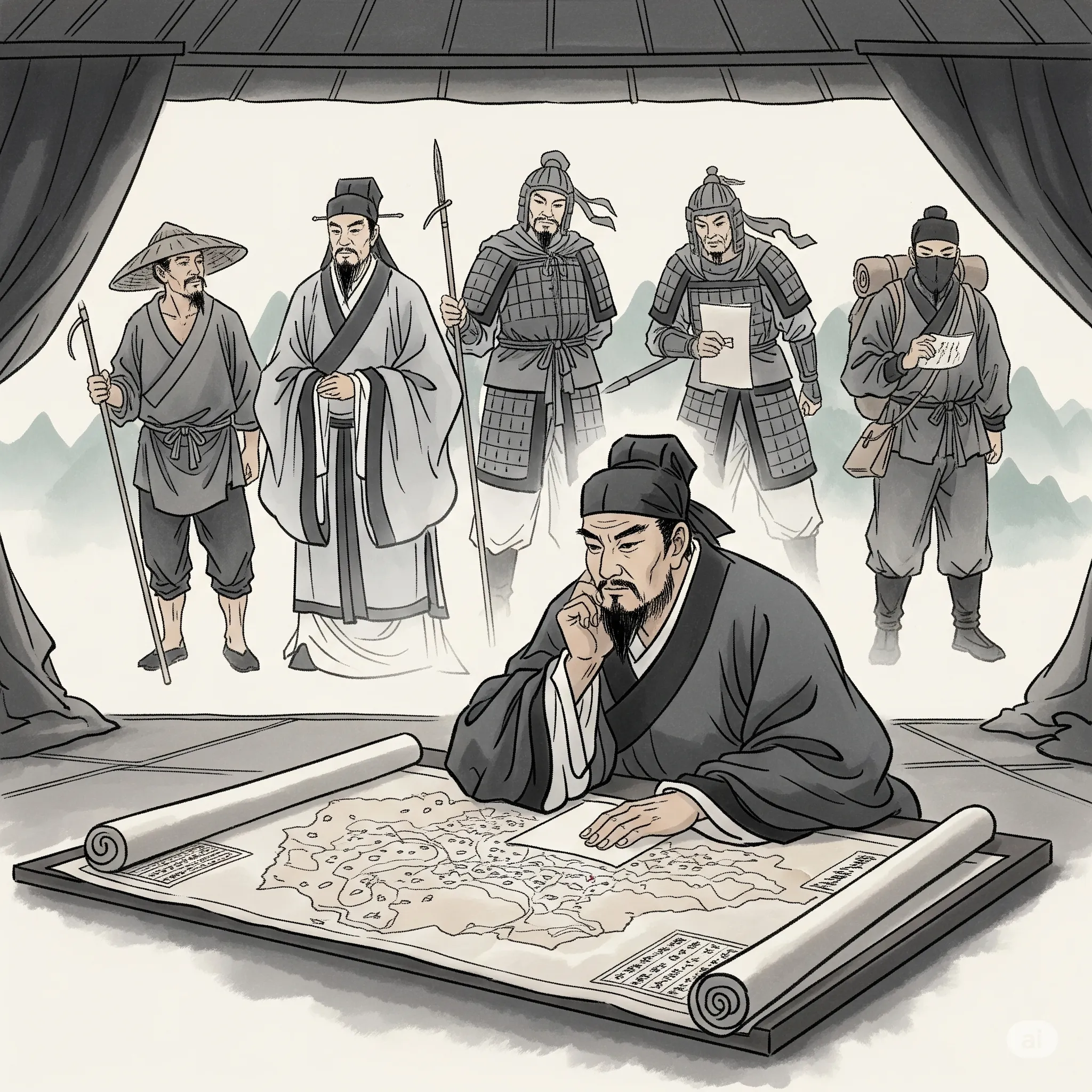
Sun Tzu classified spies into five types, a taxonomy that still maps cleanly onto modern practice:
- Local spies, recruited from the enemy’s general population.
- Inside spies, officials within the enemy’s own government.
- Reverse spies, captured enemy agents turned into double agents.
- Doomed spies, agents deliberately fed false information to carry to the enemy, usually at the cost of their lives when the deception surfaced.
- Living spies, those who go behind enemy lines and return with the report.
A capable commander, he argued, runs all five at once, weaving a web of contradictory information the enemy cannot untangle. He also insisted that spies be paid better than soldiers, since good intelligence ensures you only fight battles you have already won. With that argument, espionage stopped being an accessory to war and became its foundation.
The Twelve Spies of Canaan
Espionage runs through the ancient Middle East’s founding narratives too. The Book of Numbers records a reconnaissance mission in unusual detail. Before entering Canaan, Moses selected twelve men, one from each tribe, to scout the land. Their tasking was specific and professional: assess the land’s fertility, the strength of its inhabitants, and the nature of their fortifications.
After forty days they returned with physical evidence, including a cluster of grapes so large it hung from a pole carried between two men. Then the debrief split. All twelve agreed the land was rich, but ten of them, shaken by the fortified cities and the size of the defenders, delivered a report so fearful it demoralized the entire camp. Only two, Caleb and Joshua, dissented. The story endures as an early lesson in the dual nature of intelligence: the facts collected, and the human interpretation that decides what they mean.
Statecraft in Greece and Rome
In the classical world, espionage was an accepted instrument of statecraft, and a dangerous trade. Greek law dealt with captured foreign agents harshly. Interrogation under torture followed by execution was the standard fate of a spy caught in the wrong city.
Julius Caesar, in his Commentaries on the Gallic War, is unusually candid about his reliance on intelligence. His network layered multiple sources: Gallic traders and defectors reporting on tribal alliances, systematic interrogation of prisoners, and constant probing by scouts and speculatores. When the intelligence failed, so did he. His first expedition to Britain in 55 BCE was nearly wrecked by ignorance of the local tides and the lack of a surveyed landing site. Even for Rome, intelligence was the difference between conquest and catastrophe.
The Timeless Craft
From the legions of Rome to the warring states of China, the methods and motives of ancient espionage remain uncomfortably familiar. Technology has transformed the tools of the craft. It has not touched the fundamentals: secrecy, deception, and the relentless need to know the other side’s mind. The unseen hands of these first operatives shaped empires and wars, and they laid the foundations of the intelligence world we live in now.